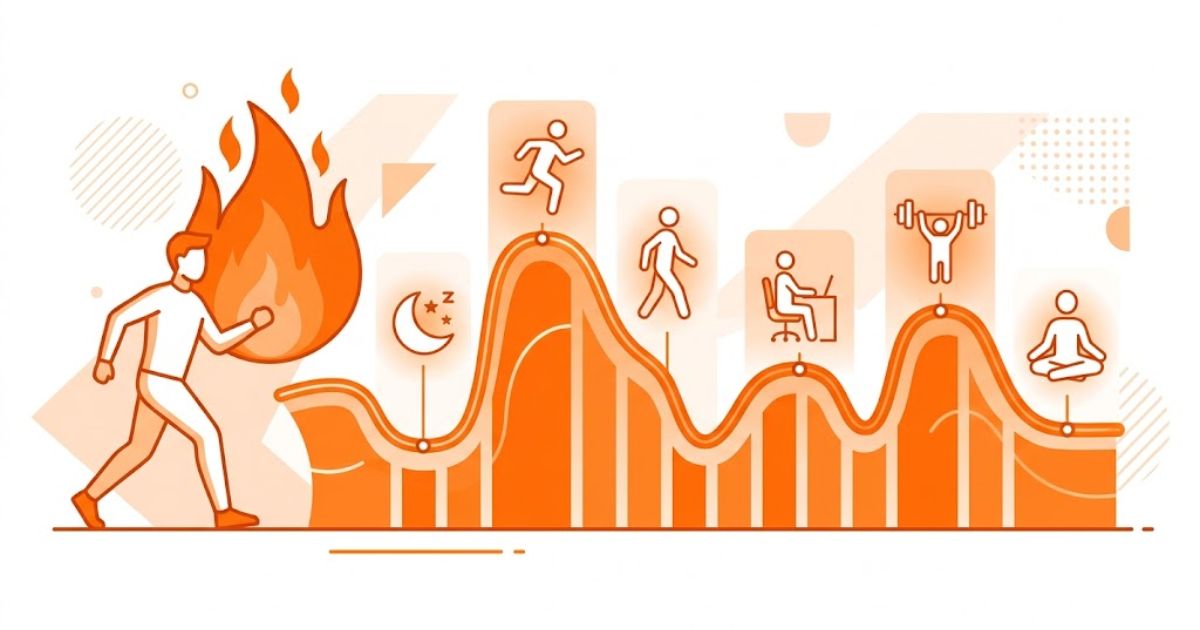
Most people trying to lose weight make the same mistake — they just "eat less" without knowing what less actually means for their body. The result? Frustration, plateaus, and giving up. TDEE fixes that problem completely.
What is TDEE?
TDEE stands for Total Daily Energy Expenditure. In simple terms, it's the total number of calories your body burns in a full 24-hour day — including everything from keeping your heart beating to your morning workout to walking to the kitchen.
It's the most important number in any weight loss or fitness plan because it tells you exactly how much energy your body needs. Eat below it — you lose weight. Eat above it — you gain weight. Match it — you stay the same.
TDEE vs BMR — What's the Difference?
A lot of people confuse TDEE with BMR. Here's the difference:
- BMR (Basal Metabolic Rate) — The calories your body burns at complete rest. Just lying in bed all day, doing nothing. It's the energy needed to keep your organs running.
- TDEE — BMR multiplied by your activity level. It accounts for everything you actually do during the day.
BMR is your baseline. TDEE is your real-world number. Always use TDEE for weight loss planning — not BMR.
How is TDEE Calculated?
TDEE is calculated in two steps. First, your BMR is estimated using the Mifflin-St Jeor formula — the most accurate method currently recommended by nutrition scientists:
- Men: BMR = (10 × weight in kg) + (6.25 × height in cm) − (5 × age) + 5
- Women: BMR = (10 × weight in kg) + (6.25 × height in cm) − (5 × age) − 161
Then your BMR is multiplied by an activity factor:
- Sedentary (little or no exercise) — BMR × 1.2
- Lightly Active (exercise 1–3 days/week) — BMR × 1.375
- Moderately Active (exercise 3–5 days/week) — BMR × 1.55
- Very Active (hard exercise 6–7 days/week) — BMR × 1.725
- Extra Active (very hard exercise or physical job) — BMR × 1.9
How to Use TDEE for Weight Loss
Once you know your TDEE, creating a calorie deficit is straightforward:
- Lose 0.5 kg per week — eat 500 calories below your TDEE daily
- Lose 1 kg per week — eat 1000 calories below your TDEE daily
- Maintain weight — eat at your TDEE
A deficit of 500 calories per day is the most recommended approach — safe, sustainable, and proven to work without triggering muscle loss or metabolic slowdown.
Common TDEE Mistakes to Avoid
Overestimating activity level. This is the most common mistake. Most people select "Moderately Active" when they're closer to "Lightly Active." Be honest — it makes a significant difference in your calorie target.
Not recalculating as you lose weight. As your weight drops, your TDEE drops too. Recalculate every 4–6 weeks to keep your deficit on track.
Treating TDEE as an exact number. TDEE is an estimate — a very useful one, but still an estimate. Track your actual weight changes over 2–3 weeks and adjust if needed.
Calculate Your TDEE Right Now
Skip the manual math. Use our free TDEE Calculator — enter your age, gender, height, weight, and activity level to get your TDEE, BMR, and personalized calorie goals for weight loss, maintenance, and muscle gain instantly.