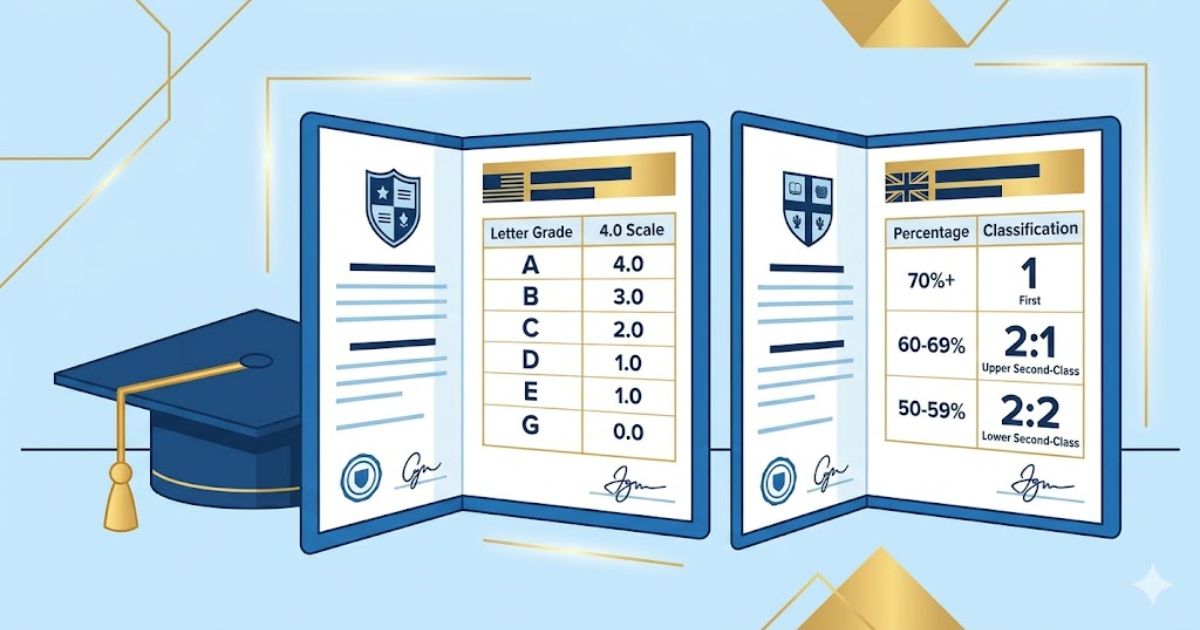
You worked hard all semester. Now grades are out and someone asks "what's your GPA?" — and suddenly you're not entirely sure how to answer. Or maybe you're a UK student applying to a US university and trying to figure out how your degree classification translates. Either way, GPA is one of those things everyone talks about but few people actually understand in detail.
What is GPA?
GPA stands for Grade Point Average. It's a single number that summarizes your academic performance across all your courses. Rather than looking at each grade individually, universities use GPA to quickly assess where a student stands overall — for admissions, scholarships, academic standing, and graduation requirements.
Simple in concept. Slightly more complicated in practice — because the US and UK calculate it very differently.
How the US GPA System Works
The US uses a 4.0 scale. Each letter grade converts to a grade point value:
- A / A+ — 4.0
- A− — 3.7
- B+ — 3.3
- B — 3.0
- B− — 2.7
- C+ — 2.3
- C — 2.0
- C− — 1.7
- D — 1.0
- F — 0.0
Your GPA is calculated by multiplying each course's grade points by its credit hours, adding everything up, and dividing by total credit hours. This is called a weighted GPA.
For example — three courses:
- English (3 credits) — B+ = 3.3 → 3 × 3.3 = 9.9
- Math (4 credits) — A = 4.0 → 4 × 4.0 = 16.0
- History (3 credits) — B = 3.0 → 3 × 3.0 = 9.0
Total grade points = 34.9 ÷ Total credits (10) = GPA 3.49
What's Considered a Good GPA in the US?
- 4.0 — Perfect, straight A's
- 3.7 – 3.9 — Excellent, strong candidate for top grad schools
- 3.3 – 3.6 — Very good, competitive for most programs
- 3.0 – 3.2 — Good, meets most requirements
- 2.5 – 2.9 — Average, may limit some opportunities
- Below 2.0 — Academic probation risk at many universities
How the UK Degree Classification System Works
The UK doesn't use GPA at all — at least not traditionally. Instead, undergraduate degrees are classified into four categories based on your overall percentage score:
- First Class Honours (1st) — 70% and above
- Upper Second Class Honours (2:1) — 60–69%
- Lower Second Class Honours (2:2) — 50–59%
- Third Class Honours (3rd) — 40–49%
A First is the highest distinction — roughly equivalent to a US GPA of 3.7–4.0. A 2:1 is considered a strong degree and is the minimum requirement for most graduate programs and competitive employers in the UK. A 2:2 is still a valid degree but limits some postgraduate and professional opportunities.
US vs UK — Key Differences
- Scale: US uses 0–4.0 points; UK uses percentage scores and classifications
- Calculation: US weights by credit hours; UK typically averages module scores (often with final year weighted more heavily)
- Grading culture: US professors give A grades more liberally; UK marking is notoriously strict — a 70% in the UK is genuinely excellent, not barely passing
- Transparency: US GPA is a single visible number; UK classification is a band, not a precise point
Converting UK Grades to US GPA
There's no perfect conversion — but the most commonly used approximation is:
- First (70%+) → US GPA 3.7 – 4.0
- 2:1 (60–69%) → US GPA 3.3 – 3.7
- 2:2 (50–59%) → US GPA 2.7 – 3.3
- Third (40–49%) → US GPA 2.0 – 2.7
Different US universities apply their own conversion standards, so always check the specific institution's policy when applying internationally.
Calculate Your GPA Instantly
Whether you're on the US or UK system, our free GPA Calculator handles both — enter your grades and credit hours to get your GPA instantly, with support for both the 4.0 US scale and UK degree classification.