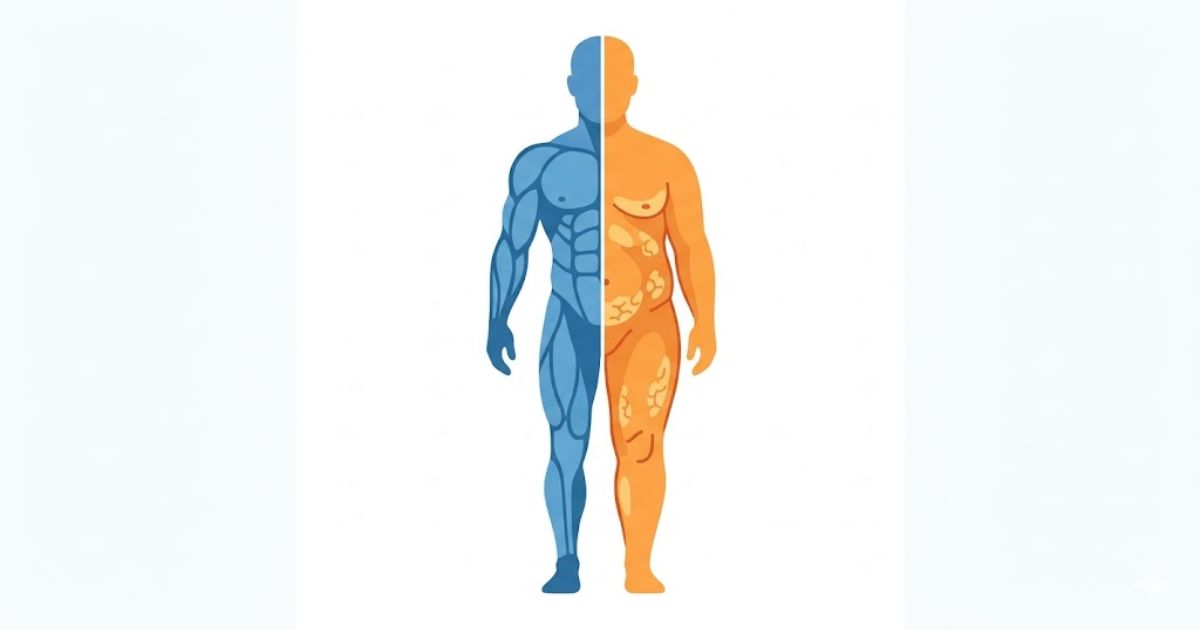
Step on a scale and you get one number. But that number doesn't tell you how much of your body is fat, how much is muscle, and how much is bone. Two people can weigh exactly 75 kg — one could be an athlete, the other at serious health risk. Body fat percentage is what separates those two stories.
So What Exactly Is Body Fat Percentage?
It's the proportion of your total body weight that comes from fat tissue. Everything else — muscle, bone, organs, water — is called lean mass. If you weigh 80 kg and carry 16 kg of fat, your body fat percentage is 20%.
Simple math. But what that number means for your health depends heavily on your gender, age, and fitness goals.
Healthy Ranges — Men vs Women
Men and women store fat very differently. Women naturally carry more essential fat due to hormonal and reproductive functions — so the healthy ranges are not the same.
For Men:
- 2–5% — Essential fat (minimum for survival)
- 6–13% — Athlete level
- 14–17% — Fitness range
- 18–24% — Average / Acceptable
- 25% and above — Obese range
For Women:
- 10–13% — Essential fat
- 14–20% — Athlete level
- 21–24% — Fitness range
- 25–31% — Average / Acceptable
- 32% and above — Obese range
Why Body Fat Matters More Than Weight
Here's something that surprises a lot of people — you can be "normal weight" on a scale and still have dangerously high body fat. This is called normal weight obesity, sometimes referred to as "skinny fat." It's more common than most people realize, and it carries many of the same health risks as clinical obesity — including increased risk of heart disease, type 2 diabetes, and metabolic syndrome.
On the flip side, a muscular person may appear "overweight" on a BMI chart while actually being in excellent health with low body fat. Weight alone is just not enough information.
What Happens When Body Fat Goes Too Low?
This doesn't get talked about enough. Going below essential fat levels is genuinely dangerous — and it happens more often than people think, especially among competitive athletes and people with disordered eating.
When body fat drops below essential levels, the body starts breaking down muscle and organ tissue for energy. In women, extremely low body fat causes hormonal disruption, loss of menstrual cycle, and accelerated bone density loss. In men, it leads to testosterone crashes, immune system suppression, and chronic fatigue.
The goal is not the lowest possible body fat — it's the right body fat for your age, gender, and lifestyle.
How is Body Fat Percentage Measured?
There are several methods, ranging from clinical to at-home estimates:
- DEXA Scan — Gold standard, most accurate, uses low-dose X-ray. Usually available at hospitals or sports clinics.
- Hydrostatic Weighing — Very accurate, involves being submerged in water. Less accessible.
- Skinfold Calipers — Trained professional pinches fat at specific body points. Good accuracy when done correctly.
- Navy Method (Tape Measure) — Uses waist, neck, and hip measurements. Surprisingly accurate for most people and completely free.
- BMI Method — Estimates body fat from height, weight, and age. Quick but less precise for muscular individuals.
What's a Realistic Goal?
If you're just starting your fitness journey, don't obsess over hitting athlete-level body fat. For most people, getting into the "fitness" range — 14–17% for men, 21–24% for women — is an excellent and realistic long-term goal that delivers real health benefits without extreme restriction.
Progress matters more than perfection. Track trends over weeks, not daily fluctuations.
Find Out Your Body Fat Right Now
Curious where you stand? Our free Body Fat Calculator uses both the Navy Method and BMI Method to estimate your body fat percentage, fat mass, lean mass, and fitness category — no gym equipment needed, just a tape measure.