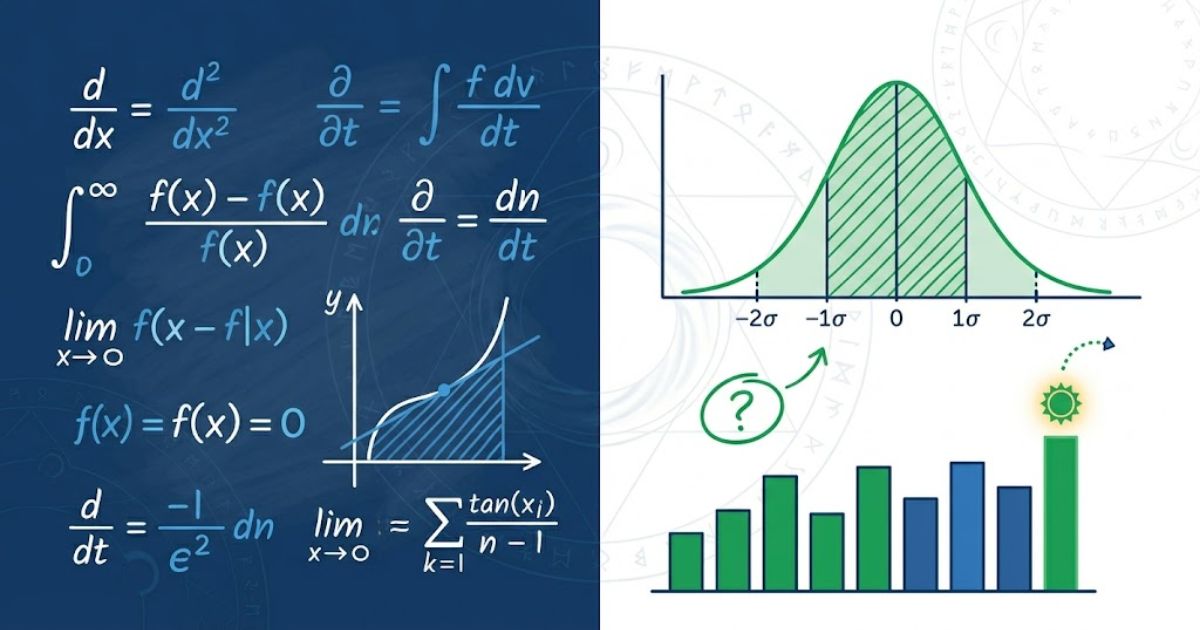
Ask this question in any high school common room and you'll start an argument. The kid who aced AP Calculus will tell you Statistics is basically not even math. The kid who got a 5 in AP Statistics will point out that half the Calculus class failed. They're both right — and they're both missing the point.
The real question isn't which one is harder in general. It's which one is harder for you — and which one actually makes sense for where you're headed.
What You're Actually Signing Up For
AP Calculus comes in two versions. AB covers the fundamentals — limits, derivatives, and basic integrals. BC covers everything in AB plus more advanced integration techniques, sequences, series, and parametric equations. BC is essentially a full year of college Calculus compressed into one course. AB is roughly one semester.
AP Statistics covers data collection, probability, and statistical inference. You'll learn how to design experiments, interpret data, and draw conclusions using methods like hypothesis testing and confidence intervals. It's less about computation and more about reasoning — understanding what numbers actually mean rather than just calculating them.
These are genuinely different subjects. Choosing between them based on which "sounds easier" is one of the more common mistakes students make.
The Calculus Case — Why It Has the Reputation It Does
Calculus has a difficulty reputation for a specific reason: it punishes weak algebra. If your foundation in functions, factoring, and trigonometry isn't solid, Calculus will feel like trying to build a second floor with no ground floor underneath. Every new concept assumes you've fully mastered everything that came before it.
The learning curve is steep and unforgiving early on. Limits feel abstract. Derivatives click for some students immediately and take weeks for others. The moment it does click though — there's a clarity to Calculus that many students find genuinely satisfying. It's logical, structured, and once you understand the rules, problems follow predictable patterns.
The AP exam itself is heavily computation-based. You will do a lot of actual math. A calculator is allowed for some sections but the exam is designed so that calculator dependency is a weakness, not a strength.
The Statistics Case — Why It Surprises So Many Students
Statistics looks easier on paper. There's less scary notation. You don't need to remember derivative rules or integration techniques. For the first few weeks, most students are comfortable — even bored.
Then inference hits.
Hypothesis testing, p-values, Type I and Type II errors, confidence intervals — this is where AP Statistics loses a huge portion of students who thought they were cruising. The difficulty in Statistics isn't computation. It's conceptual precision. You need to understand why you're doing each step and what conclusion you can and cannot draw from a result. Writing a statistically correct conclusion in free response — with exactly the right language — is genuinely harder than most students expect.
The AP Statistics exam has a significant writing component. Partial credit matters enormously. Students who struggle to explain their reasoning in words — even when their math is correct — consistently underperform on the free response section.
What the Score Data Actually Shows
Looking at College Board score distributions gives an interesting picture. AP Calculus AB and BC both tend to have a wide spread — strong students score 5s, underprepared students score 1s and 2s. The gap between prepared and unprepared is dramatic.
AP Statistics tends to cluster more in the middle. Fewer extremely high scores, but also fewer catastrophic failures. It rewards consistent, careful reasoning more than it rewards raw mathematical talent. A student who studies thoroughly and thinks clearly can do very well — regardless of how "mathy" they consider themselves.
Which One Should You Take — Honestly
There is no universally correct answer, but there are some honest guidelines:
- Take AP Calculus if you're heading into engineering, physics, computer science, mathematics, or economics. Calculus is a prerequisite for most STEM degree programmes and getting college credit for it is genuinely valuable. Also take it if you genuinely enjoy abstract mathematical thinking and your algebra is strong.
- Take AP Statistics if you're heading into biology, psychology, sociology, business, medicine, or any field that involves research and data. Statistical literacy is increasingly valuable across almost every discipline. Also take it if you're a strong writer who struggles with computation-heavy math.
- Take both if your schedule allows it and you're genuinely interested in quantitative fields. Many universities want to see both, and students who understand both calculus and statistics are significantly better equipped for college-level science and economics courses.
The One Thing Both Exams Reward Equally
Showing your work. In both AP Calculus and AP Statistics free response sections, a correct final answer with no supporting work earns minimal credit. An incorrect final answer with clearly shown, mostly correct reasoning earns substantial partial credit. This is not a small detail — it's the difference between a 3 and a 4 for many students.
Whatever you write, explain what you're doing and why. Every step. Every time.
Predict Your AP Score Right Now
Already taken your exam — or doing practice tests and want to know where you stand? Use our score calculators to get an estimated 1–5 score based on your multiple choice and free response performance. We have dedicated calculators for both AP Calculus AB and AP Statistics — enter your estimated scores and see your predicted result instantly.