You've probably heard the term BMI thrown around at a doctor's office or on a fitness app. But most people either don't know what it actually means — or they think it tells the whole story. It doesn't. And that's exactly what we're going to clear up today.
What Does BMI Actually Stand For?
BMI stands for Body Mass Index. It's a number calculated from your height and weight, and it's used as a quick screening tool to estimate whether a person's weight falls in a healthy range.
The Formula is Simple
BMI = Weight (kg) ÷ Height (m²)
So if you weigh 70 kg and you're 1.75 meters tall, your BMI is 70 ÷ (1.75 × 1.75) = 22.9
What Do the Numbers Mean?
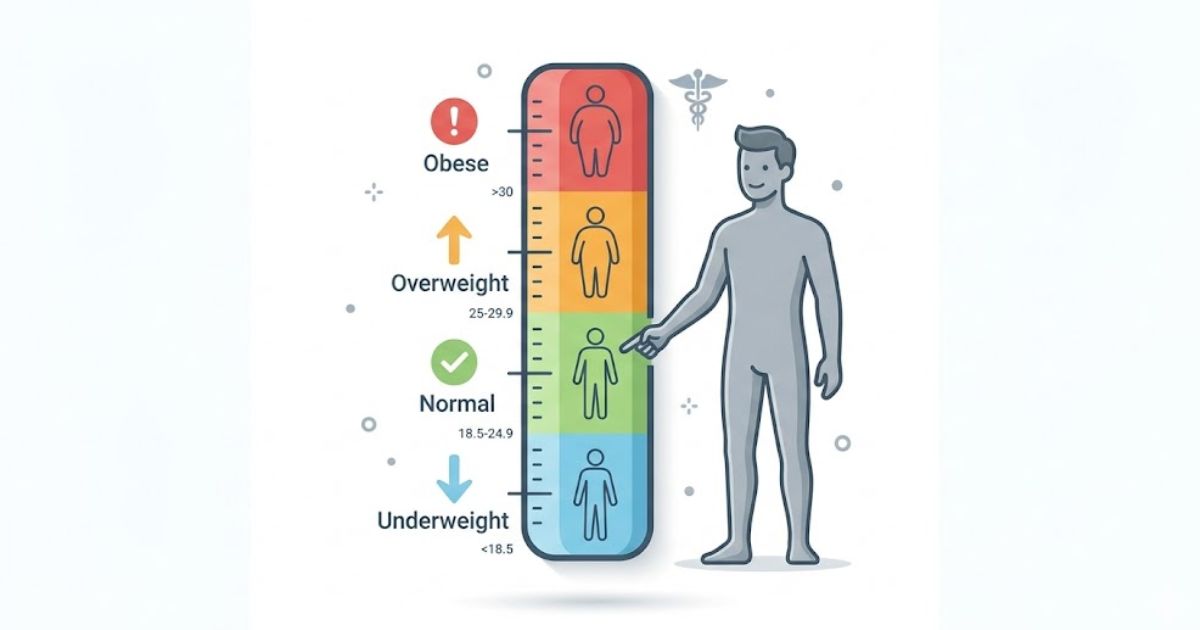
According to the World Health Organization, BMI categories for adults are:
- Below 18.5 — Underweight
- 18.5 to 24.9 — Normal / Healthy Weight
- 25 to 29.9 — Overweight
- 30 and above — Obese
These ranges apply to most adults regardless of age or gender, though some guidelines adjust slightly for different ethnicities.
Why Was BMI Created?
BMI wasn't originally designed to measure individual health. It was created in the 1830s by a Belgian mathematician named Adolphe Quetelet — not a doctor — to study population statistics. It was never meant to diagnose individual health conditions. It was only adopted widely by the medical community in the 1970s as a convenient screening shortcut.
Where BMI Gets It Right
For the general population, BMI does a reasonably good job of flagging weight-related health risks. Studies consistently show that people with a BMI above 30 face higher risks of type 2 diabetes, heart disease, high blood pressure, and joint problems. People with a BMI below 18.5 face risks like nutritional deficiencies, weakened immunity, and bone density loss.
As a population-level screening tool, it works. The problem starts when we treat it as a precise personal health verdict.
Where BMI Gets It Wrong
Here's what BMI completely ignores:
- Muscle mass. A professional athlete or bodybuilder can have a BMI of 28 or 29 — technically "overweight" — while carrying very little body fat. Their weight comes from dense, heavy muscle tissue, not fat.
- Fat distribution. Two people can have the exact same BMI but store fat in completely different places. Visceral fat — the fat stored around your organs in your midsection — is far more dangerous than fat stored under the skin. BMI can't tell the difference.
- Bone density. People with denser, heavier bones can score higher on BMI without any extra fat.
- Age and gender. Women naturally carry more body fat than men at the same BMI. And older adults tend to carry more fat at the same BMI compared to younger adults. The standard ranges don't fully account for this.
So Should You Still Care About Your BMI?
Yes — but with context. BMI is a useful starting point, not a final verdict. If your BMI is in the normal range and you feel healthy and active, great. If it's elevated, it's worth paying attention to — but don't panic based on one number alone.
Pair your BMI with other indicators like waist circumference, body fat percentage, blood pressure, and energy levels for a much more complete picture of your health.
Want to check your BMI right now? Use our free BMI Calculator — it supports both Metric and Imperial units and gives you your category and healthy weight range instantly.